
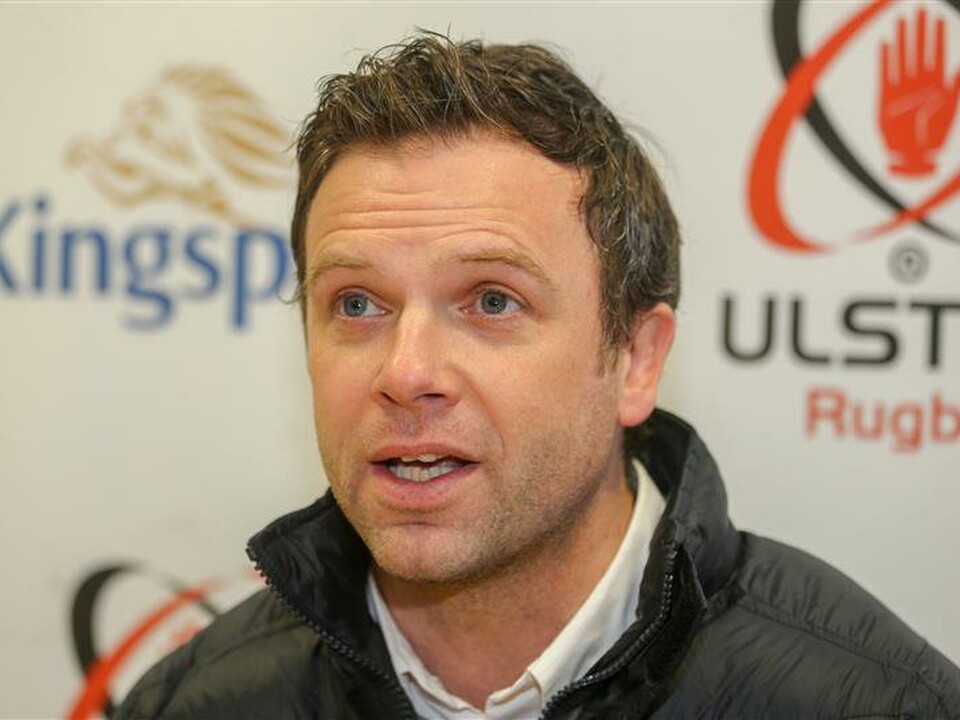
Bryn, can you give us an overview of the Player Pathway?
I suppose it is essentially the lifeblood of Ulster Rugby.
Without a highly functioning system in below the pro game, there is no solid foundation, and that could easily lead to sustainability issues of being able to compete consistently at the highest level, and to be able to plan effectively for the future.
The identification of players at the appropriate age level, and the nurturing of those players along the way, are absolutely key elements. Every player's journey can look different and with Rugby being such a late-maturation sport, providing opportunities for players and particularly late developers to enter at different stages of the Pathway, is critical.
We are also acutely aware there are many stakeholders involved here that have to work together effectively to achieve the main aim - which is to develop the individual, and provide them with the best experiences and a platform to succeed.
So trying to create a coherent Pathway that everybody can buy into with mutual benefits along the way can be very challenging, but hugely rewarding when you see the positive results that can materialise. A great example of this were the standout performances of a few of our highest potential current Pathway players in the Danske Bank Schools' Cup this season.
The Player Pathway already has many successful graduates. Could you share with us a few examples of players with different journeys through the program?
With the Pathway there are probably no two journeys that are identical.
If you take James Hume for example, he has come through the very traditional route. He's starred at one of the big traditional Rugby schools and played all his Age-Grade representative rugby along the way. He was a shoo-in for the Academy and has ultimately gone on to be a regular starter for the Ulster senior team, and has achieved senior Ireland recognition.
At the other end of the spectrum, the non-traditional route, we have Shea O'Brien who's just been awarded a new 2 year senior contract due to the significant improvement he's making behind the scenes. With the increased attention that we put on AIL rugby, his success at club level has afforded him opportunities to be selected for our A team. He's taken those, but because he wasn't in an intense rugby Pathway Programme, he wasn't afforded the exposure to the levels of physical development required to compete at the highest level.
He's now got a lot of that under his belt over the last 10 months, and the improvements are significant which will hopefully result in a player who, over the course of the next 2 seasons, starts to put real pressure on the coaches for first team selection.
More recently, helped by the significance of the new NTS programme, when we have good alignment with all stakeholders, we can see exciting talents coming through the system.
The Danske Bank Schools' Cup final this year was a really good advert in particular for a few NTS players who have really accelerated in their physical development, such as Jacob Boyd, Bryn Ward, and Lukas Kenny. We would expect to see those guys who have been identified early, had excellent school coaching, and had exposure to additional support from the Pathway, really excel among their peers at the highest level. These are guys we hope to see play a big part in the future of Ulster Rugby in years to come.
As head of Rugby Operations and Recruitment, your role is closely aligned with the senior men's game, so what benefits do you think the Pathway will bring to the professional game going forward?
My main role is primarily tied into the senior squad and making sure we have a really clear and coherent succession plan.
There are a number of KPIs that sit under me that make the seniors and the Pathway completely interrelated and utterly dependent on each other. Finding a balance between staying within budget, having a squad that with the right coaching ticket is highly competitive and consistently competing at the sharp end of competitions, while staying true to the identity of Ulster Rugby, is always hugely challenging but very rewarding to see in action.
Outside of a few foreign positions which we will always require to support those aims - on which we need to provide a good case to the IRFU - we have free rein effectively to amass the squad around that.
If we are to continue to invest in and evolve our Pathway then it's essential we see a high proportion of the players in the senior squad coming through that system, and ideally a large number within a European match day 23, the pinnacle of club rugby. Already, over the last 3 years, those numbers have risen significantly and the projection will continue to do so through to 2025/26.
Having a pipeline of quality players is essential to facilitate this.
Sometimes it can be cyclical, you have a stronger year followed by a slightly weaker one in terms of National Underage selection, but the key is to make sure there are not 2-3 years in a row where representation is poor. If we have a scarcity in a particular position, which we can clearly see on the depth chart, then at times we will have no choice but to look outside of Ulster for that talent.
It's important to add that outside influence which can be massively beneficial and add to the whole culture of Ulster Rugby. You only have to look at Alan O'Connor and what he's brought to Ulster through his leadership and his attitude on the pitch, or Greg Jones behind the scenes, who may not get selected a lot of the time but his influence around training and first team preparation for the weekend must not be underestimated. Both came through our Academy and are examples of players who you always need to supplement the core group of Ulster Pathway players.
Can you tell us more about the partnership with QUB and what impact it will have?
I've been working for Ulster Rugby for over 8 years now and the relationship with QUB was something that has been talked about from before I even came in, so it has taken a long time to get to this point. A lot of conversations, a lot of presentations, but ultimately this is something we believe in wholeheartedly.
In essence, it's having a core group of like-minded young players training and also playing regularly together with access to excellent facilities, playing at the requisite level that will stretch them, and being coached by a Queen's team that are in constant communication with our Academy team to make sure we're really well aligned. This can only be beneficial for the acceleration in development of those individuals in the long run.
Ultimately, we hope that two things transpire from this.
Firstly, that we get the majority of our high performing players through into the senior setup more robust and already aligned to many of the core principles we have in place. Secondly, we hope that the playing and learning experience is such that, for those that don't quite come through, we want to see those players reintegrated into club rugby from Queen's and add real value to the club and participation side of the game.
It's imperative for us that club rugby continues to thrive and grow. Top to bottom we want the Pathway to have the ability to facilitate all parts of Ulster Rugby, whether immediately or in the longer run.
Read more about the Ulster Rugby Player Pathway here.