
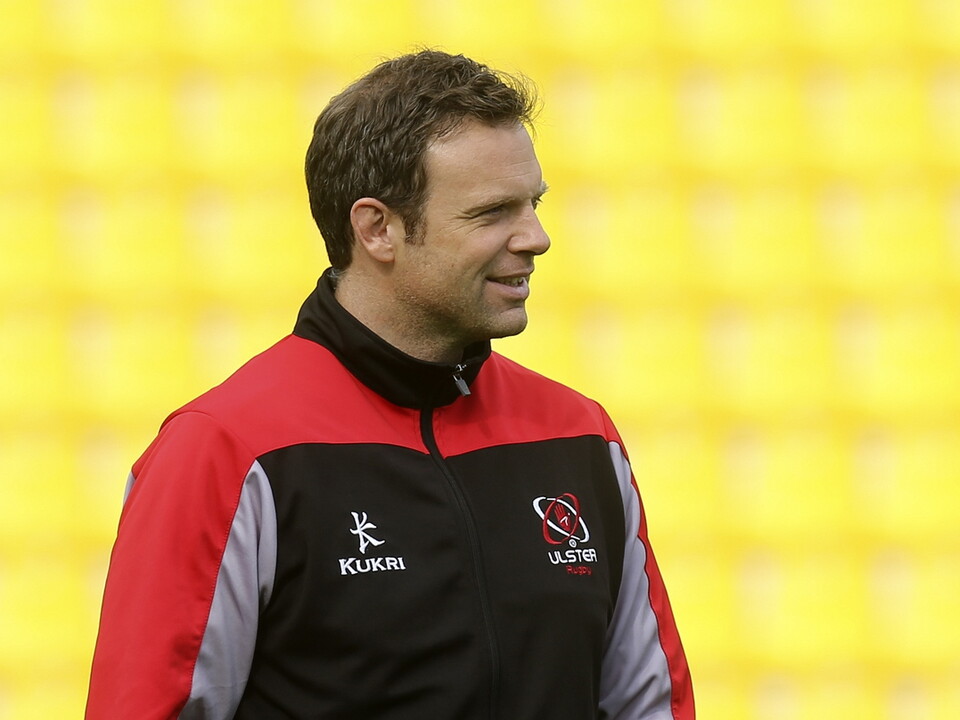
Bryn Cunningham gives an insight into his role as Operations Director and shares his views on the ongoing enhancement of the playing roster at Ulster...
Can you give us an insight into what your role entails on a weekly basis?
It’s a bit of a cliché, but no two weeks are the same. My diary is my lifeline with, internal meetings across various strands of the organisation, plus external meetings with the IRFU, agents and prospective players.
My core roles include: developing the succession plan of the squad, player retention and recruitment, negotiation of all playing and coaching contracts, Academy functionality and how it feeds into the senior squad. I also manage the overall budget of the professional game.
A big focus of my time at present is looking at the strategy of the organisation over the next 3-5-year period, which will hopefully commence formally within the next few months.
In terms of player movement, can you give us a quick update on where Ulster is at the moment and how do you hope to shape the squad going forward?
We are delighted to have recently re-signed Luke Marshall, Rob Herring and Kieran Treadwell on long-term deals. Having a core group of quality players with the right character committing long term gives stability to the Province and shows the desire these players have to achieve silverware with Ulster, something we all crave.
We don’t have the finances of the English and French markets, we have restrictions in terms of who we can recruit in terms of non-Irish qualified players and we have a relatively small indigenous player pool. When you add all those things to the mix, retention of key players is paramount in building towards a squad required to take on the best in Europe and beat them.
I’m a bit of a traditionalist at heart and having been a ‘one-club-man’ myself for 13 years, I strongly believe that a sense of loyalty can still exist in the modern era. There are some intangibles, more important than short-term monetary gain, that I try to impress on certain players when, ultimately, they reflect on their careers down the line.
I’m also in constant communication with the IRFU and players’ agents on national contracts, which are critical to our budget forecasting.
In terms of recruitment, we have already added Marty Moore and Jordi Murphy to our roster for next season, which will provide us with greater strength in our front-line squad.
Over the last couple of seasons, we’ve highlighted what we need coming through the Academy, in terms of position, type of player and character. We have some grizzly, uncompromising forwards coming through over the next 3-5 years, who could provide the backbone of our team and reinforce some of the traditions of what Ulster Rugby was built on decades ago. When you add in some of the talent in the backs and pace in the outside channels only entering our Academy now, I am very optimistic about the future.
Getting the right blend of leadership, hardness, competitiveness and talent will be key to rejuvenating Ulster, staying true to our roots but evolving at the pace required to win trophies.
How are the Academy players getting on? Are any future homebred Ulster stars likely to move into the full-time squad soon?
There is great integration between the Academy and senior squads, in which Kieran Campbell (Academy Manager) is integral. A big reason we hoped to get someone like Willie Anderson in there as Forwards Coach, was again to highlight the type of player we have lacked coming through for a number of years - physical and uncompromising.
Good examples of this are the likes of Adam McBurney, Matty Dalton and Aaron Hall whom, if they apply themselves professionally, will have very successful futures with Ulster Rugby, if not the national team. Other guys making big impressions already would be players such as Tom O’Toole and Greg Jones in the pack and importantly, at halfback, with Johnny Stewart and Michael Lowry. We expect big things from those listed above (and others hopefully) over the next few years!
What do you look for when recruiting overseas players like Charles Piutau and Marcell Coetzee?
There are a number of things and the criteria is never identical across positions. Taking Charles as an example, the aim was to find someone who had a rounded game, so he could play across a number of positions. This was key for two reasons. Firstly, we don’t want to prevent young talent in the system not having a chance to break through and secondly, with injuries such a massive part of the game now, having the ability to shift players around is vital.
Critically, the player had to have a serious X-factor to their play, as those types of players are often the difference between winning and losing tight games.
The right character is also essential; that the player would fit into our culture and thrive, become a leader and have the ability to mentor younger players. In this instance, I believe we achieved everything we were after with Charles.
However, a player can still tick all the criteria you are after but be ravaged by injury and there is very little you can do about it. In Marcell Coetzee’s case, the damage he does at ruck time and his explosive ball-carrying ability were key attributes we were after but his unfortunate injury before arriving with us and the further injuries he has sustained means we have only seen very small glimpses of the huge contribution he offers.
Mainly, it’s soul destroying for the player. For the club, with player welfare being something we take very seriously, irrespective of the contractual obligation, all that our Medical and Strength & Conditioning team can do is make every effort to get them back to full fitness.
What are your main challenges in terms of recruitment?
It’s a hugely competitive market out there for a start! When you consider that we can only recruit up to a maximum of 4 foreign players and 1 special project player, it immediately limits you.
Due to the small numbers, you often find that Southern Hemisphere players may go to a French or English club because these clubs average between 14 and 18 foreigners and the incoming player is likely to have friends or former teammates plying their trade there.
Players’ partners will clearly have a big say in this, as the move is always more difficult for them as they don’t have the day-to-day contact with people that the player does. Familiarity can be key for them.
Financially, while we are always very competitive, we can rarely rely on providing the best remuneration package, so we need to sell the Ulster brand in many other ways, which we believe are among the bets in Europe. Those are personal to us and as points of difference I would tend to keep private as much as possible.
A lot of quality overseas players also want to come to a club that has a realistic capability of winning silverware. Ideally, we need to be consistently in the knock-out stages of the PRO14, if not Europe too, if we want to continually attract some of the best talent out there.
Timing is often everything and no two players are on exactly the same time lines in terms of making decisions.
Strong relationships with agents is key to stay ahead of the curve. In our current group of five overseas players, they are represented by five different agents from four different companies, which shows the importance of having a strong global network.
Finally, how to do think the current squad compares to this time last year?
I believe it is undoubtedly stronger. I also believe that next year we will be stronger again. The depth is getting better, as we now have Development players and even Academy players capable of playing and competing at PRO14 level, something we didn’t have two years ago.
Therefore, the foundations are getting better, meaning you become less reliant on your starting 15 staying injury-free week-in-week-out in order to compete against the best sides.
However, we are also realistic and know that if we are to compete on two fronts, we need to have better luck with injuries and availability to key personnel.
Can you give us an insight into what your role entails on a weekly basis?
It’s a bit of a cliché, but no two weeks are the same. My diary is my lifeline with, internal meetings across various strands of the organisation, plus external meetings with the IRFU, agents and prospective players.
My core roles include: developing the succession plan of the squad, player retention and recruitment, negotiation of all playing and coaching contracts, Academy functionality and how it feeds into the senior squad. I also manage the overall budget of the professional game.
A big focus of my time at present is looking at the strategy of the organisation over the next 3-5-year period, which will hopefully commence formally within the next few months.
In terms of player movement, can you give us a quick update on where Ulster is at the moment and how do you hope to shape the squad going forward?
We are delighted to have recently re-signed Luke Marshall, Rob Herring and Kieran Treadwell on long-term deals. Having a core group of quality players with the right character committing long term gives stability to the Province and shows the desire these players have to achieve silverware with Ulster, something we all crave.
We don’t have the finances of the English and French markets, we have restrictions in terms of who we can recruit in terms of non-Irish qualified players and we have a relatively small indigenous player pool. When you add all those things to the mix, retention of key players is paramount in building towards a squad required to take on the best in Europe and beat them.
I’m a bit of a traditionalist at heart and having been a ‘one-club-man’ myself for 13 years, I strongly believe that a sense of loyalty can still exist in the modern era. There are some intangibles, more important than short-term monetary gain, that I try to impress on certain players when, ultimately, they reflect on their careers down the line.
I’m also in constant communication with the IRFU and players’ agents on national contracts, which are critical to our budget forecasting.
In terms of recruitment, we have already added Marty Moore and Jordi Murphy to our roster for next season, which will provide us with greater strength in our front-line squad.
Over the last couple of seasons, we’ve highlighted what we need coming through the Academy, in terms of position, type of player and character. We have some grizzly, uncompromising forwards coming through over the next 3-5 years, who could provide the backbone of our team and reinforce some of the traditions of what Ulster Rugby was built on decades ago. When you add in some of the talent in the backs and pace in the outside channels only entering our Academy now, I am very optimistic about the future.
Getting the right blend of leadership, hardness, competitiveness and talent will be key to rejuvenating Ulster, staying true to our roots but evolving at the pace required to win trophies.
How are the Academy players getting on? Are any future homebred Ulster stars likely to move into the full-time squad soon?
There is great integration between the Academy and senior squads, in which Kieran Campbell (Academy Manager) is integral. A big reason we hoped to get someone like Willie Anderson in there as Forwards Coach, was again to highlight the type of player we have lacked coming through for a number of years - physical and uncompromising.
Good examples of this are the likes of Adam McBurney, Matty Dalton and Aaron Hall whom, if they apply themselves professionally, will have very successful futures with Ulster Rugby, if not the national team. Other guys making big impressions already would be players such as Tom O’Toole and Greg Jones in the pack and importantly, at halfback, with Johnny Stewart and Michael Lowry. We expect big things from those listed above (and others hopefully) over the next few years!
What do you look for when recruiting overseas players like Charles Piutau and Marcell Coetzee?
There are a number of things and the criteria is never identical across positions. Taking Charles as an example, the aim was to find someone who had a rounded game, so he could play across a number of positions. This was key for two reasons. Firstly, we don’t want to prevent young talent in the system not having a chance to break through and secondly, with injuries such a massive part of the game now, having the ability to shift players around is vital.
Critically, the player had to have a serious X-factor to their play, as those types of players are often the difference between winning and losing tight games.
The right character is also essential; that the player would fit into our culture and thrive, become a leader and have the ability to mentor younger players. In this instance, I believe we achieved everything we were after with Charles.
However, a player can still tick all the criteria you are after but be ravaged by injury and there is very little you can do about it. In Marcell Coetzee’s case, the damage he does at ruck time and his explosive ball-carrying ability were key attributes we were after but his unfortunate injury before arriving with us and the further injuries he has sustained means we have only seen very small glimpses of the huge contribution he offers.
Mainly, it’s soul destroying for the player. For the club, with player welfare being something we take very seriously, irrespective of the contractual obligation, all that our Medical and Strength & Conditioning team can do is make every effort to get them back to full fitness.
What are your main challenges in terms of recruitment?
It’s a hugely competitive market out there for a start! When you consider that we can only recruit up to a maximum of 4 foreign players and 1 special project player, it immediately limits you.
Due to the small numbers, you often find that Southern Hemisphere players may go to a French or English club because these clubs average between 14 and 18 foreigners and the incoming player is likely to have friends or former teammates plying their trade there.
Players’ partners will clearly have a big say in this, as the move is always more difficult for them as they don’t have the day-to-day contact with people that the player does. Familiarity can be key for them.
Financially, while we are always very competitive, we can rarely rely on providing the best remuneration package, so we need to sell the Ulster brand in many other ways, which we believe are among the bets in Europe. Those are personal to us and as points of difference I would tend to keep private as much as possible.
A lot of quality overseas players also want to come to a club that has a realistic capability of winning silverware. Ideally, we need to be consistently in the knock-out stages of the PRO14, if not Europe too, if we want to continually attract some of the best talent out there.
Timing is often everything and no two players are on exactly the same time lines in terms of making decisions.
Strong relationships with agents is key to stay ahead of the curve. In our current group of five overseas players, they are represented by five different agents from four different companies, which shows the importance of having a strong global network.
Finally, how to do think the current squad compares to this time last year?
I believe it is undoubtedly stronger. I also believe that next year we will be stronger again. The depth is getting better, as we now have Development players and even Academy players capable of playing and competing at PRO14 level, something we didn’t have two years ago.
Therefore, the foundations are getting better, meaning you become less reliant on your starting 15 staying injury-free week-in-week-out in order to compete against the best sides.
However, we are also realistic and know that if we are to compete on two fronts, we need to have better luck with injuries and availability to key personnel.